Introduction
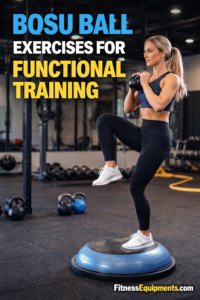
BOSU ball exercises for functional training focus on improving how the body moves in real-world situations rather than isolating individual muscles. Functional training emphasizes coordination, balance, stability, and strength working together so movements translate directly to daily life, sport, and work activities.
The BOSU ball is especially effective for functional training because it introduces controlled instability. This forces the body to stabilize joints, maintain alignment, and coordinate multiple muscle groups at once. BOSU ball exercises for functional training help reinforce proper movement patterns while improving balance and control under load.
Functional Training Explained
Functional training is designed to improve movement efficiency by training patterns rather than single muscles. Common patterns include squatting, hinging, lunging, pushing, pulling, rotating, and carrying. These patterns appear repeatedly in everyday tasks such as lifting objects, climbing stairs, reaching overhead, or changing direction.
Instead of focusing on maximal strength in a single plane of motion, functional training emphasizes joint stability, coordination, and control through multiple planes. This approach supports injury prevention, improved posture, and better performance in both athletic and non-athletic populations.
BOSU ball exercises for functional training enhance these qualities by challenging balance and proprioception while reinforcing proper mechanics.
Why Use a BOSU Ball for Functional Training
BOSU ball exercises for functional training are effective because the unstable surface increases neuromuscular demand. The body must constantly adjust to maintain balance, which improves communication between the nervous system and muscles.
This instability also encourages joint alignment and controlled movement. Poor technique becomes immediately noticeable when balance is lost, providing instant feedback. Over time, BOSU training helps develop stronger stabilizers around the ankles, knees, hips, shoulders, and core, which are essential for safe and efficient movement.
Safety, Setup, and Technique Basics
- Place the BOSU ball on a flat, non-slip surface.
- Choose dome-side-up or dome-side-down based on the exercise and experience level.
- Maintain neutral spine alignment and controlled posture.
- Move deliberately; avoid rushing repetitions.
- Stop if balance or form deteriorates.
Functional training prioritizes quality over intensity. Proper setup and controlled execution are essential when using a BOSU ball.
7 BOSU Ball Exercises for Functional Training
1. BOSU Squat
Purpose: Trains the squat pattern while improving ankle, knee, and hip stability.
Setup: Stand on the BOSU dome with feet shoulder-width apart and chest upright.
Execution cues: Sit back into the hips, keep knees tracking over toes, and maintain balance as you return to standing.
Functional benefit: Improves lower-body control for lifting and standing tasks.
2. BOSU Reverse Lunge
Purpose: Reinforces unilateral strength and balance.
Setup: Stand on the BOSU dome with one foot; step the opposite leg back into a reverse lunge.
Execution cues: Keep the front knee stable and torso upright as you lower and return.
Functional benefit: Enhances balance during stepping and directional changes.
3. BOSU Step-Up
Purpose: Develops leg strength and coordination through a common movement pattern.
Setup: Place one foot on the BOSU dome and the other on the floor behind you.
Execution cues: Drive through the planted foot to stand tall, then step back down under control.
Functional benefit: Supports stair climbing and single-leg stability.
4. BOSU Push-Up (Hands on Dome)
Purpose: Trains pushing strength with added shoulder and core stability.
Setup: Place hands on the BOSU dome in a plank position.
Execution cues: Lower the chest with control while keeping the body aligned.
Functional benefit: Improves upper-body control for pushing and bracing tasks.
5. BOSU Lateral Step-Over
Purpose: Trains lateral movement and coordination.
Setup: Stand beside the BOSU and step laterally onto the dome, then over to the other side.
Execution cues: Keep hips level and movement smooth.
Functional benefit: Enhances side-to-side control and agility.
6. BOSU Single-Leg Balance Reach
Purpose: Builds single-leg stability and proprioception.
Setup: Stand on one foot on the BOSU dome.
Execution cues: Reach the free foot forward, sideways, or backward while maintaining balance.
Functional benefit: Improves balance for walking and dynamic movement.
7. BOSU Standing Rotation Hold
Purpose: Trains rotational control and trunk stability.
Setup: Stand on the BOSU dome holding a light resistance band or medicine ball.
Execution cues: Rotate slowly while keeping hips stable.
Functional benefit: Supports twisting and turning movements in daily life and sport.
Programming for Functional Training
BOSU ball exercises for functional training are best programmed using moderate repetitions and controlled tempo. Aim for 8–12 repetitions per exercise or 30–45 seconds of continuous movement.
Functional circuits work well. Combine lower-body, upper-body, and rotational movements to reinforce full-body coordination. Rest 45–60 seconds between exercises.
Two to three sessions per week are sufficient for most individuals when combined with strength or cardiovascular training.
Progressions and Regressions
To regress BOSU ball exercises for functional training, reduce range of motion, slow the tempo, or use bilateral stances. Progress by increasing movement complexity, adding light resistance, or reducing points of contact.
Progressions should enhance control, not compromise balance or posture.
Integration With Broader Training Goals
BOSU ball exercises for functional training integrate well into warm-ups, movement prep sessions, or standalone functional workouts. They complement strength training by reinforcing stability and support cardiovascular training by improving movement efficiency.
Consistency and movement quality are more important than intensity when using BOSU-based functional exercises.
Conclusion
BOSU ball exercises for functional training improve how the body moves by reinforcing real-world movement patterns under controlled instability. These seven exercises help build balance, coordination, and strength that transfer directly to everyday tasks and athletic performance. When performed consistently with proper technique, BOSU training becomes a powerful tool for functional movement development.


