Introduction
BOSU ball exercises for beginners provide a controlled way to improve balance, stability, and body awareness without high impact or heavy loads. For individuals new to instability training, the BOSU ball offers just enough challenge to activate stabilizing muscles while remaining approachable and adaptable.
Beginners often struggle with balance and coordination, especially when transitioning into new training environments. BOSU ball exercises for beginners focus on slow, deliberate movement and static control, helping build a foundation that supports future strength, endurance, and functional training.
Balance and Stability Explained
Balance is the ability to maintain control of your body’s position, whether standing still or moving. Stability refers to the body’s ability to resist unwanted movement while maintaining proper alignment. Together, these qualities allow you to move efficiently and safely.
For beginners, balance and stability training is essential. Weak stabilizers can lead to poor posture, compensations, and increased injury risk. BOSU ball exercises for beginners encourage the nervous system and muscles to work together, improving coordination and control over time.
Why Use a BOSU Ball for Beginner Training
BOSU ball exercises for beginners are effective because the instability is adjustable. Simply standing on the dome creates a challenge, while additional movement can be added gradually as confidence improves.
The BOSU ball also provides immediate feedback. Small shifts in balance highlight weaknesses and encourage correction. This makes beginner training more intentional, reinforcing proper alignment and controlled movement from the start.
Safety, Setup, and Technique Basics
- Place the BOSU ball on a flat, non-slip surface.
- Start with the dome side up for all beginner exercises.
- Wear supportive footwear or go barefoot for better ground awareness.
- Keep movements slow and controlled.
- Use a wall, chair, or rail for support when needed.
If balance is lost, step off the BOSU safely rather than trying to save the position. Stability improves through repetition, not forcing difficulty.
7 BOSU Ball Exercises for Beginners
1. BOSU Basic Stand
Purpose: Introduces balance training and builds confidence.
Setup: Step onto the center of the BOSU dome with both feet hip-width apart.
Execution cues: Stand tall, engage the core lightly, and focus on a fixed point ahead. Keep knees soft and breathing steady.
Beginner target: Hold for 30–60 seconds.
2. BOSU Weight Shift
Purpose: Improves controlled balance transitions.
Setup: Stand on the BOSU with both feet planted.
Execution cues: Slowly shift weight from side to side, then forward and back, without lifting the feet.
Beginner target: 8–12 controlled shifts in each direction.
3. BOSU March in Place
Purpose: Introduces single-leg balance.
Setup: Stand tall on the BOSU dome.
Execution cues: Lift one foot slightly, lower it, then alternate. Keep hips level and movement slow.
Beginner target: 10–16 total marches.
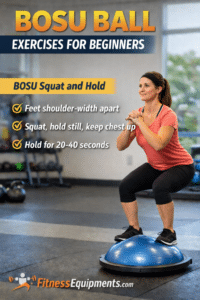
4. BOSU Half Squat Hold
Purpose: Builds lower-body stability and posture.
Setup: Stand on the BOSU with feet shoulder-width apart.
Execution cues: Lower into a shallow squat and hold. Keep chest upright and knees tracking over toes.
Beginner target: Hold for 20–40 seconds.
5. BOSU Alternating Toe Taps
Purpose: Improves coordination and balance control.
Setup: Stand on the BOSU.
Execution cues: Lightly tap one foot forward, return to center, then alternate sides.
Beginner target: 8–12 taps per side.
6. BOSU Seated Balance Hold
Purpose: Develops core stability in an upright position.
Setup: Sit tall on the BOSU dome with feet on the floor.
Execution cues: Engage the core and lift one foot slightly, then switch. Progress to lifting both feet briefly if stable.
Beginner target: 30–60 seconds total.
7. BOSU Step-On and Off
Purpose: Teaches controlled entry and exit from instability.
Setup: Stand behind the BOSU.
Execution cues: Step onto the center of the dome with one foot, bring the other foot up, then step off carefully.
Beginner target: 6–10 controlled repetitions per side.
Programming for Beginners
BOSU ball exercises for beginners should emphasize quality over quantity. Two to three short sessions per week are sufficient. Choose three to five exercises per session and focus on control rather than fatigue.
Rest as needed between exercises. Balance training should feel challenging but manageable, not rushed or exhausting.
Progressions and Regressions
To regress BOSU ball exercises for beginners, use external support, reduce hold times, or slow movements further. To progress, increase duration before adding movement or reducing support.
Avoid advancing too quickly. Consistent, controlled practice builds long-term balance and confidence.
Integration With Broader Training Goals
BOSU ball exercises for beginners work well in warm-ups, recovery sessions, or standalone balance routines. As stability improves, these exercises prepare beginners for more advanced BOSU training, strength work, and functional movement.
Conclusion
BOSU ball exercises for beginners offer a safe, effective way to develop balance, stability, and coordination. By focusing on controlled movement and gradual progression, beginners can build a strong foundation that supports long-term fitness and injury prevention.


