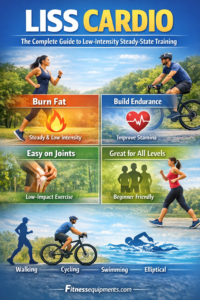
LISS cardio is one of the most effective and sustainable ways to build cardiovascular endurance, burn fat, and support long-term fitness goals. Short for low-intensity steady-state, this training style involves maintaining a consistent, moderate effort over an extended period. Unlike high-intensity methods that push you to your limits, it keeps your heart rate in a comfortable zone where your body relies primarily on fat for fuel.
Whether you are just starting your fitness journey or looking for a way to complement harder training days, this guide covers everything you need to know about steady-state training and how to make it work for you.
What Is LISS Cardio?
LISS cardio refers to any aerobic activity performed at a low, steady intensity for a sustained period, typically between 30 and 60 minutes. The goal is to keep your heart rate at roughly 50 to 65 percent of your maximum throughout the session. At this effort level, your breathing stays controlled, you can hold a conversation, and your body draws most of its energy from stored fat rather than glycogen.
Common forms include brisk walking, light cycling, easy-pace swimming, rowing at a moderate tempo, and using an elliptical at a comfortable resistance. The defining feature is consistency of effort. You are not sprinting, not resting, and not fluctuating between hard and easy intervals. You maintain one steady pace from start to finish.
How LISS Cardio Burns Fat
Your body uses different fuel sources depending on exercise intensity. During low-intensity activity, your aerobic energy system dominates. This system prefers fat as its primary fuel because fat oxidation is efficient when oxygen supply is abundant and energy demand is moderate. As a result, a higher percentage of the calories you burn during steady-state sessions come directly from fat stores compared to higher-intensity exercise.
That said, total calorie expenditure matters as well. A 45-minute low-intensity session may burn fewer total calories than a 20-minute high-intensity workout. However, the lower impact on your nervous system and joints means you can train more frequently without accumulating excessive fatigue. Over the course of a week, this consistency often leads to greater total fat oxidation for many people.
Additionally, this style of training improves your mitochondrial density over time. Mitochondria are the structures within your cells responsible for producing energy. The more mitochondria you develop, the more efficient your body becomes at burning fat, both during exercise and at rest.
Benefits of LISS Cardio
The advantages extend well beyond fat loss. This training method supports multiple dimensions of physical and mental health, making it a valuable addition to nearly any fitness routine.
Improved Cardiovascular Health
Sustained low-intensity activity strengthens your heart muscle and improves the efficiency of your circulatory system. Over time, your resting heart rate decreases, your stroke volume increases, and your blood vessels become more responsive. These adaptations reduce your risk of heart disease and improve your overall cardiovascular endurance, which is the foundation for virtually every other physical goal.
Better Recovery Between Workouts
Low-intensity steady-state movement promotes blood flow to muscles without creating additional tissue damage. This makes it an excellent active recovery tool. Many athletes and recreational exercisers use a light session the day after a hard strength training workout to reduce soreness and speed up the recovery process. The increased circulation delivers nutrients to damaged muscle tissue and helps flush metabolic waste products.
Accessible for All Fitness Levels
Because intensity stays low, this approach is suitable for beginners, older adults, individuals recovering from injury, and anyone who finds high-intensity exercise intimidating or unsustainable. There is no barrier to entry. Walking qualifies. So does a gentle bike ride. You do not need special skills, advanced conditioning, or expensive equipment to get started.
Mental Health and Stress Reduction
Low-intensity movement has well-documented effects on stress hormones and mood regulation. A steady 30 to 45-minute walk or bike ride lowers cortisol levels, stimulates the release of endorphins, and provides a meditative quality that many people find calming. For those managing anxiety or depression alongside their fitness goals, LISS cardio offers a low-pressure way to stay active without adding physical or psychological strain.
Who Should Try LISS Cardio
This method is not limited to any single demographic or experience level. However, certain groups benefit especially from including it in their training.
Beginners who are building a fitness foundation will find steady-state cardio far more approachable than interval training or circuit-based programs. It allows you to establish an exercise habit without the soreness and burnout that often accompany high-intensity starts.
Experienced lifters and athletes frequently use it as a recovery tool and as a way to build aerobic capacity without interfering with strength or power goals. Because LISS cardio places minimal demand on the central nervous system, it pairs well with intense resistance training schedules.
Older adults and those managing joint issues also benefit from the low-impact nature of steady-state training. Activities like walking, swimming, and cycling place far less stress on knees, hips, and ankles than running or jumping.
How to Start a LISS Cardio Routine
Getting started requires very little planning. Choose an activity you enjoy and can sustain for at least 30 minutes at a comfortable pace. Walking is the simplest option, but cycling, swimming, rowing, and elliptical training all qualify as long as you keep the intensity low and steady.
Aim for three to five sessions per week, each lasting between 30 and 60 minutes. Use a heart rate monitor if possible and keep your heart rate between 50 and 65 percent of your estimated maximum. A simple formula to estimate your maximum heart rate is 220 minus your age. If you are 40 years old, your maximum is approximately 180 beats per minute, and your target zone would fall between 90 and 117 beats per minute.
Start conservatively. If 30 minutes feels challenging, begin with 20 minutes and add five minutes each week. The goal is to build the habit first and increase duration gradually. Consistency matters far more than session length in the early stages.
LISS Cardio vs HIIT: Key Differences
LISS cardio and HIIT are often positioned as competing approaches, but they serve different purposes and work best when used together.
HIIT involves short bursts of all-out effort followed by rest or low-intensity recovery periods. Sessions are typically 15 to 30 minutes and produce a significant afterburn effect, meaning your metabolism stays elevated for hours after the workout. However, HIIT places heavy demands on your muscles, joints, and nervous system, which limits how often you can perform it without risking overtraining or injury.
Steady-state training, by contrast, can be performed daily without significant recovery consequences. It builds your aerobic base, supports fat oxidation, and serves as active recovery. Most well-designed training programs include both methods. A common approach is two to three HIIT sessions per week alongside three to four low-intensity sessions, adjusting the balance based on your specific goals and recovery capacity.
Common LISS Cardio Mistakes to Avoid
The most frequent mistake is going too hard. If you are breathing heavily, unable to speak in full sentences, or feeling significant muscle fatigue, you have crossed out of the low-intensity zone. The whole point is to stay comfortable and steady. Pushing the intensity defeats the purpose and turns the session into moderate-intensity cardio, which is a different training stimulus entirely.
Another common error is making sessions too short. While any movement is better than none, LISS cardio needs at least 30 minutes to produce meaningful fat-burning and cardiovascular adaptations. Your body takes roughly 15 to 20 minutes to fully shift into the aerobic fat-burning mode, so cutting sessions short leaves benefits on the table.
Finally, some people rely exclusively on steady-state training and neglect resistance work and higher-intensity efforts. While this method is excellent for endurance and fat loss, it does not build muscle, improve power, or challenge your anaerobic energy systems. A balanced program incorporates low-intensity sessions alongside strength training and occasional high-intensity work.
Frequently Asked Questions About LISS Cardio
How long should a session last?
Most sessions last between 30 and 60 minutes. Beginners can start with 20 minutes and work up from there. The key is maintaining a steady, low-intensity effort throughout.
Can I do LISS cardio every day?
Yes. Because the intensity is low, it places minimal stress on your body and can be performed daily. Many people use it as an active recovery method on rest days from strength training.
Is walking considered LISS cardio?
Absolutely. Brisk walking is one of the most popular and accessible forms of steady-state cardio. As long as you maintain a steady pace that keeps your heart rate in the 50 to 65 percent range, walking qualifies.
Will this type of training help me lose weight?
LISS cardio supports weight loss by burning calories and prioritizing fat as a fuel source. However, weight loss ultimately depends on maintaining a calorie deficit through a combination of exercise and nutrition. Steady-state training is one effective tool within a larger strategy.
References
American Heart Association. “Target Heart Rates Chart.” https://www.heart.org/en/healthy-living/fitness/fitness-basics/target-heart-rates