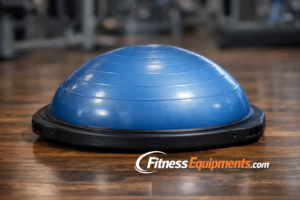
1. Introduction: What a BOSU Ball Actually Is
At first glance, the BOSU ball looks deceptively simple: a rubber half-dome attached to a rigid plastic platform. In gyms and clinics, it is often treated as a prop—something to stand on, kneel on, or balance over—rather than an object with its own logic and design intent. This narrow framing has led to a common misconception that the BOSU ball is merely a novelty balance toy or a piece of “extra” equipment with no serious purpose.
In reality, the BOSU ball represents a specific design philosophy centered on controlled instability. It is neither a gimmick nor a universal solution, but a deliberately engineered tool that sits between stable ground and fully unstable surfaces. To understand what a BOSU ball actually is, it helps to look beyond exercise demonstrations and examine its origins, construction, biomechanics, and the reasons it has remained relevant for more than two decades.
This article focuses on the BOSU ball itself: how it is designed, what it changes mechanically and neurologically, why people respond to it the way they do, and where it fits—and does not fit—within modern movement culture.
2. Origins and Naming: Where BOSU Came From
The term BOSU stands for “Both Sides Up,” a name that is more descriptive than it first appears. The device was developed in the late 1990s by David Weck, at a time when balance training and proprioceptive tools were gaining traction in rehabilitation and athletic preparation. Unlike Swiss balls, which are fully unstable, the BOSU was conceived as a hybrid: unstable enough to challenge balance, yet stable enough to be approachable.
The naming mattered. “Both Sides Up” explicitly encouraged exploration of the object’s dual orientation, reinforcing the idea that the BOSU was not a single-purpose surface. This helped differentiate it from earlier balance tools and positioned it as a versatile platform rather than a fixed apparatus.
The BOSU emerged during a period when fitness equipment was becoming more experiential and less purely load-driven. Its design aligned with growing interest in coordination, injury prevention, and movement quality, which contributed to its rapid adoption across multiple domains.
3. Physical Design and Engineering
The BOSU ball consists of two primary components: a molded rubber dome and a rigid plastic base. Each part plays a specific role in how the device behaves under load.
The dome is made from a thick, elastic rubber compound designed to deform predictably. When force is applied, it compresses and rebounds without collapsing, providing resistance while maintaining structural integrity. This elasticity is central to the BOSU’s function: it allows motion without randomness.
The base is flat, rigid, and textured. Its stiffness contrasts with the dome’s compliance, creating a clear distinction between the two sides. The rim around the base adds stability and prevents excessive rolling when the dome is facing upward.
Geometrically, the half-sphere shape is critical. A full sphere would be too unstable for most users and too difficult to control. By halving the sphere and anchoring it to a platform, the BOSU limits degrees of freedom while preserving enough movement to challenge balance. This design choice makes the instability scalable rather than absolute.
Load ratings and material thickness are also intentional. The BOSU is designed to tolerate bodyweight and moderate external loads while discouraging excessive force production that would undermine control or safety.
4. Instability as a Feature, Not a Flaw
Instability is often treated as a drawback in physical systems, but in the BOSU ball it is the primary feature. The key distinction lies in the type of instability it creates. The BOSU provides controlled instability, meaning that movement occurs within predictable boundaries.
Unlike wobble boards, which tilt sharply along fixed axes, or Swiss balls, which can roll freely in any direction, the BOSU dampens motion. The dome deforms under pressure, slowing movement and providing sensory feedback before balance is lost. This predictability allows users to adapt rather than react blindly.
This middle-ground behavior explains why the BOSU feels challenging without being chaotic. It introduces uncertainty while still offering enough structure for learning. From a design perspective, this balance between movement and control is what differentiates the BOSU from many short-lived fitness tools.
5. Biomechanics and Neuromuscular Effects
Standing, kneeling, or loading on a BOSU ball changes how the body organizes itself. The unstable surface alters proprioceptive input—the sensory information that tells the brain where joints and limbs are in space. As a result, the nervous system increases muscle co-contraction around joints to maintain alignment.
This effect is particularly noticeable at the ankle, knee, hip, and trunk. Rather than relying on passive structures or single prime movers, the body distributes effort across multiple stabilizing muscles. Center-of-mass control becomes more demanding, even when external loads are light.
Research suggests that unstable surfaces like the BOSU reduce maximum force output compared to stable ground. This is not a flaw but a trade-off. The BOSU shifts emphasis away from peak strength and toward coordination, timing, and control. Understanding this distinction is crucial for using the tool appropriately and evaluating claims made about it.
6. Psychological and Behavioral Dimensions
The BOSU ball’s appeal is not purely mechanical. Psychologically, unstable surfaces feel engaging because they demand attention. Small adjustments create immediate feedback, which can make movement feel interactive rather than repetitive.
There is also an element of play. The BOSU introduces novelty without overwhelming the user, which can increase adherence and willingness to explore movement. For some, it builds confidence by making balance challenges feel safe and contained. For others, it introduces just enough uncertainty to remain interesting.
These behavioral factors help explain why people continue to use the BOSU even when simpler tools could achieve similar physical outcomes. Engagement matters, especially in long-term movement practice.
7. Adoption Across Domains
The BOSU ball has been adopted in rehabilitation clinics, athletic facilities, group fitness studios, and home gyms. Its success lies in its adaptability rather than specialization.
In rehabilitation, it is used to reintroduce controlled instability. In sports contexts, it serves as a transitional surface between therapy and full return to play. In group fitness, it functions as an accessible challenge that scales across ability levels. At home, it offers variety without requiring large amounts of space or setup.
Many fitness tools experience brief popularity before disappearing. The BOSU’s continued presence suggests that it fills a niche that has not been fully replaced.
8. Criticism, Misuse, and Misunderstanding
The BOSU ball is not without criticism. Common complaints include claims that it is ineffective for strength development, unnecessarily risky, or over-marketed. Some of these critiques are valid, particularly when the BOSU is used in contexts where stability and force production are the priority.
However, many criticisms stem from misuse rather than inherent flaws. Expecting the BOSU to replace stable loading tools misunderstands its purpose. Like any tool, its value depends on alignment between design and application.
Marketing has occasionally overstated its benefits, contributing to unrealistic expectations. Distinguishing between what the BOSU is designed to do and what it is sometimes advertised to do helps clarify its actual role.
9. The BOSU Ball as a Design Case Study
From a design standpoint, the BOSU ball is notable for its simplicity. It contains no electronics, no adjustable components, and no complex mechanisms. Its versatility comes from geometry and material choice rather than technological complexity.
Visually, it is instantly recognizable. Functionally, it invites experimentation. These qualities have helped it persist in an industry that often favors novelty over longevity. The BOSU demonstrates how thoughtful constraints can produce durable design.
10. Conclusion: What the BOSU Ball Represents
The BOSU ball is more than an exercise accessory. It represents a shift toward valuing control, awareness, and adaptability in movement. While it is not suitable for every goal or context, it fills an important space between stability and chaos.
Its continued relevance suggests that simple, well-designed tools can outlast trends when they address real needs. Understanding what a BOSU ball is—and what it is not—allows it to be used with clarity rather than hype.
FAQ: Common Questions About the BOSU Ball
What is a BOSU ball used for?
A BOSU ball is used as an unstable surface to challenge balance, coordination, and neuromuscular control rather than to maximize force or load.
Why is it called a BOSU ball?
The name BOSU stands for “Both Sides Up,” referring to the fact that the device can be used with either the dome or the platform facing upward.
Is a BOSU ball good for beginners?
Yes, because its instability is controlled and predictable, making it more approachable than fully unstable tools.
What makes a BOSU ball different from a balance board?
A balance board typically tilts along fixed axes, while the BOSU deforms under load, creating multidirectional but dampened movement.
Are BOSU balls backed by science?
Research supports their effects on balance, proprioception, and stabilization, while also showing their limitations for maximal strength output.
Reference
Behm, D. G., & Colado, J. C. (2012). The effectiveness of resistance training using unstable surfaces and devices for rehabilitation. International Journal of Sports Physical Therapy.
https://www.ncbi.nlm.nih.gov/pmc/articles/PMC3325639/


