If you have ever wondered what is muscular endurance, you are not alone. It is one of the most important yet misunderstood components of physical fitness. In simple terms, muscular endurance is the ability of a muscle or group of muscles to perform repeated contractions against resistance over an extended period. Whether you are holding a plank, cycling uphill, or carrying groceries up three flights of stairs, your muscular endurance is doing the work. This guide breaks down seven key things you need to know about this essential fitness quality, from how it works inside your body to the best ways to train it.
What Is Muscular Endurance and How Does It Work
At its core, muscular endurance refers to how long your muscles can sustain effort before they fatigue. It is not about producing a single burst of maximum force. Instead, it measures your ability to keep going rep after rep or hold a position for an extended time without giving out.
Your body relies on two energy systems to fuel this process. During lower-intensity, sustained efforts, aerobic metabolism dominates. Oxygen is used to break down carbohydrates and fats into usable energy. As intensity rises and oxygen supply falls short, your body shifts to anaerobic pathways that produce energy more quickly but generate lactic acid as a byproduct. That burning sensation during a long set of squats is lactic acid building up faster than your body can clear it.
Slow-twitch muscle fibers, also called Type I fibers, play the largest role in muscular endurance. These fibers are built for sustained, low-force output and resist fatigue far longer than their fast-twitch counterparts. Consistent endurance training increases the density of capillaries and mitochondria within these fibers, which improves oxygen delivery and energy production over time. The result is muscles that can work harder for longer before reaching failure.
Muscular Endurance vs Muscular Strength
People often confuse muscular endurance with muscular strength, but they measure very different physical qualities. Muscular strength is the maximum amount of force a muscle can produce in a single effort. A one-rep max deadlift is a test of strength. Muscular endurance, on the other hand, is about sustaining submaximal force across many repetitions or over a sustained period of time.
Consider the difference in practical terms. A powerlifter who squats 500 pounds once may not be able to squat 135 pounds for 50 repetitions. A marathon runner can maintain a steady pace for hours yet may struggle to lift heavy loads off the floor. Both athletes are fit, but they have trained opposite ends of the strength-endurance spectrum. Understanding where you fall on this spectrum helps you design a training program that matches your personal goals.
7 Benefits of Training Muscular Endurance
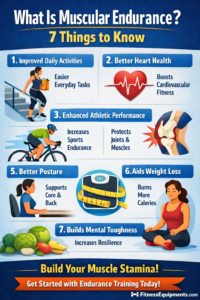
Now that you know what is muscular endurance, it is worth looking at why it matters. Building this quality delivers benefits that reach well beyond the gym. Here are seven worth knowing about.
First, it improves daily functional performance. Activities like climbing stairs, carrying bags, and standing for long periods become noticeably easier when your muscles resist fatigue more efficiently. Second, it supports cardiovascular health. Endurance-focused training keeps your heart rate elevated for longer periods, which strengthens your heart and improves circulation over time.
Third, it enhances athletic performance. Sports like soccer, swimming, cycling, and rowing demand repeated muscular effort across extended time frames, and muscular endurance training directly supports those demands. Fourth, it reduces injury risk. Muscles that fatigue quickly force your joints and connective tissues to absorb more stress. Better endurance means your muscles stay engaged longer and protect the structures around them.
Fifth, it promotes better posture. The postural muscles in your core, back, and shoulders need to work continuously throughout the day. Greater endurance in these areas helps you maintain proper alignment and reduces chronic discomfort. Sixth, it aids in weight management. Endurance training sessions typically burn a significant number of calories because they involve sustained effort over longer durations.
Seventh, it builds mental toughness. Pushing through long sets and sustained holds trains your mind to manage discomfort and resist the urge to quit. This psychological resilience carries over into every area of life, from work deadlines to personal challenges.
How to Test Your Muscular Endurance
Testing your muscular endurance gives you a measurable baseline and a reliable way to track progress over time. Several common assessments are used in fitness settings, and none of them require expensive equipment.
The push-up test measures upper body endurance. You perform as many push-ups as possible with proper form until you reach failure. Your results are then compared against established age and gender norms to gauge where you stand. The plank hold is a widely used test for core endurance. You hold a standard forearm plank position for as long as possible while maintaining correct alignment. Holding for more than 60 seconds is generally considered good for most adults.
The bodyweight squat test targets lower body endurance. You complete as many squats as you can at a steady pace without resting between reps. Tracking your count every four to six weeks reveals clear and motivating progress. These simple tests make it easy for anyone at any fitness level to measure improvement and stay accountable to their training plan.
Best Exercises to Build Muscular Endurance
Effective muscular endurance training focuses on higher repetitions, lighter loads, and shorter rest periods. The goal is to keep muscles working under sustained tension long enough to trigger adaptation.
Bodyweight exercises are an excellent starting point. Push-ups, squats, lunges, and planks challenge multiple muscle groups simultaneously and can be scaled to any ability level. Aim for sets of 15 to 25 repetitions or timed holds of 30 to 90 seconds per exercise.
Circuit training is another powerful approach. By moving through a series of exercises with minimal rest between stations, you maintain an elevated heart rate while demanding repeated effort from your muscles. A typical circuit might include jumping jacks, bodyweight rows, step-ups, and mountain climbers performed for 45 seconds each with 15 seconds of transition time between movements.
Resistance training with lighter weights and higher rep ranges also develops muscular endurance effectively. The American College of Sports Medicine recommends using 40 to 60 percent of your one-rep max for sets of 15 or more repetitions with rest periods under 90 seconds. This places the training stimulus squarely in the endurance zone rather than the strength or hypertrophy zone.
Activities like swimming, cycling, and rowing work well too. These demand continuous muscular effort over extended periods and train endurance in both the upper and lower body at the same time.
Common Mistakes That Stall Your Progress
Several training errors can slow your muscular endurance gains considerably. Recognizing and avoiding them keeps your progress moving forward.
Going too heavy is the most frequent mistake. When the load is too high, you sacrifice repetitions and shift the training effect toward pure strength rather than endurance. Keep the weight moderate and focus on completing more reps with controlled form. Resting too long between sets is another common issue. Endurance training requires shorter rest intervals, typically 30 to 60 seconds. Longer breaks allow full muscular recovery and reduce the fatigue stimulus your muscles need in order to adapt.
Neglecting nutrition and hydration undermines performance as well. Muscles rely on glycogen to sustain repeated efforts, and even mild dehydration impairs endurance rapidly. Eating balanced meals and drinking enough water throughout the day creates the foundation your training depends on. Finally, skipping progression stalls results over time. Your body adapts to repeated stimuli, so you need to gradually increase your reps, reduce rest periods, or extend hold times to keep your muscles challenged.
FAQ
How often should I train muscular endurance?
Training muscular endurance two to four times per week provides enough stimulus for adaptation while giving your muscles adequate time to recover. Beginners should start at the lower end of that range and increase frequency as their fitness improves. Spreading sessions across the week with at least one rest day between sessions targeting the same muscle groups helps prevent overtraining.
Can muscular endurance training build muscle size?
Muscular endurance training can produce moderate increases in muscle size, especially in beginners who are new to resistance exercise. However, it is not the most efficient approach for hypertrophy. Programs that use heavier loads in the 6 to 12 repetition range with longer rest periods are better suited for building significant muscle mass. Endurance training and hypertrophy training can be combined within a well-structured program.
Is muscular endurance important for older adults?
Muscular endurance is especially valuable for older adults because it supports balance, joint stability, and the ability to perform daily tasks independently. Low-impact endurance exercises like wall sits, seated leg extensions, and resistance band movements offer effective and accessible starting points. Maintaining muscular endurance as you age helps preserve quality of life and reduces the risk of falls and injuries.