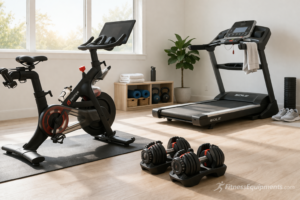
Every article ranking exercise equipment for weight loss makes the same argument: find the machine that burns the most calories per hour and buy that one. Treadmills top the list, rowing machines follow close behind, and the logic seems airtight — more calories burned means more weight lost. Except it doesn’t work that way in practice, and the evidence is sitting in garages and spare bedrooms across the country in the form of expensive, barely-used equipment. The ranking system is broken not because the calorie numbers are wrong, but because it is measuring the wrong thing entirely. The machine that burns the most calories for someone who quits after three weeks burns zero calories for the other forty-nine weeks of the year. This article makes the case for ranking exercise equipment for weight loss by the standard that actually determines results — consistency — and shows you how to choose the right equipment based on that standard instead.
Why Calorie-Burn Rankings Fail Real People
The calorie-per-hour metric used to rank exercise equipment for weight loss is not meaningless — it is just incomplete. It measures peak performance under controlled conditions from subjects who are motivated, properly trained, and using the equipment correctly. It does not measure what happens when the novelty wears off, when the machine feels repetitive, when an injury flares up, or when life simply gets in the way of a 60-minute rowing session.
The research on exercise adherence tells a different story than the calorie charts. Studies consistently show that enjoyment and perceived effort are among the strongest predictors of whether someone continues exercising long-term. A person who genuinely enjoys cycling at a moderate pace five days a week will lose significantly more weight over a year than a person who endures brutal rowing intervals twice a week before abandoning the machine entirely. The equipment that wins on paper rarely wins in the real world, because the real world includes boredom, soreness, time pressure, and the fundamental human tendency to stop doing things that feel like punishment.
The Variable Nobody Ranks For: Adherence
Adherence — the ability to keep showing up — is the single most important variable in long-term weight loss, and it is the one variable that no exercise equipment ranking accounts for. This is partly because adherence is harder to measure than calories, and partly because it is deeply individual. What keeps one person coming back to the gym consistently might be the same thing that drives another person away.
Understanding your own adherence profile before choosing exercise equipment for weight loss is more valuable than any top-ten list. Ask yourself three questions before spending a dollar: Do I prefer solo or social exercise? Do I respond better to low-impact steady effort or high-intensity short bursts? And critically — what exercise have I actually sustained for more than three months at any point in my life? The answers to those questions will tell you more about which machine belongs in your home than any calorie comparison chart ever will.
Reassessing the Most Popular Exercise Equipment for Weight Loss
Treadmills
The treadmill tops almost every calorie-burn ranking, and for good reason — walking and running are natural human movements that engage the whole body and can be sustained at varying intensities for long periods. But the treadmill is also the most abandoned piece of exercise equipment for weight loss in the home gym market. The reason is not the machine itself. It is the monotony of running in place without the environmental stimulation that makes outdoor running enjoyable for most people. Modern treadmills with interactive screens, virtual routes, and live classes have addressed this significantly — but they come at a cost that puts them out of reach for many buyers. If you are someone who ran or walked consistently before and found it genuinely enjoyable, a treadmill is an excellent choice. If you have never sustained a running habit outdoors, there is little reason to believe you will sustain one indoors on a machine.
Rowing Machines
Rowing machines generate enormous enthusiasm in fitness circles and consistently rank near the top of calorie-burn lists. They are also among the most technically demanding pieces of exercise equipment for weight loss available to home buyers. Proper rowing form takes time to learn, and poor form produces lower back strain that sidelines many users before they have built a sustainable habit. For people who invest the time to learn the technique and find the rhythm of rowing meditative rather than tedious, these machines deliver outstanding results. For everyone else, the technical barrier and the repetitive motion become reasons to stop. Rowing machines reward patience and a willingness to develop skill — if that description fits you, they are worth serious consideration.
Stationary Bikes
The stationary bike is consistently underrated in weight loss rankings because its calorie burn per hour sits below the treadmill and rowing machine under typical conditions. What the rankings miss is that stationary bikes have one of the highest adherence rates of any cardio equipment, for two reasons: they are genuinely low-impact, making them accessible to people with knee, hip, and joint issues that rule out running; and the cycling motion is natural and comfortable enough that most people can sustain it for longer sessions without the effort feeling disproportionate to the output. An hour on a stationary bike at moderate intensity three times a week, sustained for twelve months, produces far better weight loss results than a higher-intensity machine used sporadically. Spin-style bikes with clip-in shoes and structured class programming have also transformed home cycling into a social, high-energy experience that drives exceptional consistency in the right personality type.
Elliptical Trainers
The elliptical occupies a unique position in the exercise equipment for weight loss market. It burns fewer calories than a treadmill at equivalent effort levels, which is why it ranks lower on most lists. But it is also one of the most joint-friendly cardio options available, making it the correct choice for a significant portion of the population who cannot sustain running without injury. The elliptical also engages the upper body when the arm handles are used actively rather than passively gripped for balance — a point that most reviews mention but few users actually apply. If you have existing joint issues or a history of lower body injuries that have derailed previous exercise habits, the elliptical’s lower impact profile may be the factor that keeps you exercising consistently when other equipment would force you to stop.
Strength Training Equipment
Adjustable dumbbells, kettlebells, and cable machines rarely appear in rankings of exercise equipment for weight loss because their immediate calorie burn is lower than dedicated cardio machines. This is one of the most misleading omissions in fitness content. Strength training builds muscle mass, and muscle tissue burns more calories at rest than fat tissue — meaning the metabolic benefits of strength training extend well beyond the workout itself. According to the CDC’s physical activity guidelines for adults, muscle-strengthening activities on two or more days per week provide health benefits that cardio alone cannot replicate, including improved body composition and increased resting metabolic rate. For people whose weight loss has plateaued on cardio equipment alone, the missing variable is almost always resistance training. Adjustable dumbbells in particular offer the best return on investment of any exercise equipment for weight loss in the home setting — they are compact, scalable, and support an enormous variety of movements that keep training varied enough to sustain long-term.
The Equipment Combination That Actually Produces Results
The most effective approach to exercise equipment for weight loss is not choosing the single highest-performing machine. It is building a setup that covers both cardiovascular training and resistance training in a way that you will realistically sustain. For most home gym buyers, this means one cardio machine chosen for adherence rather than peak calorie burn, combined with a set of adjustable dumbbells or a compact cable system for strength work.
The cardio machine should be chosen based on your personal history with exercise, your joint health, and your honest assessment of what you find tolerable or enjoyable over repeated sessions. The strength component should be chosen for versatility — the ability to progress in resistance as you get stronger, and the ability to perform enough different movements that workouts stay varied. This combination addresses weight loss from both directions simultaneously: calories burned during cardio sessions and elevated resting metabolism from accumulated muscle mass.
Space and Budget Are Not Limitations — They Are Filters
Most exercise equipment for weight loss guides treat space and budget as afterthoughts addressed in a brief final section. They are actually the first filters that should shape your decision, not because they limit your options but because they force a more honest conversation about what you will actually use.
A treadmill that folds against the wall in a small apartment gets used. A commercial-grade rowing machine stored in a garage that requires clearing space before every session gets used less. Equipment that is inconvenient to access does not get used consistently, regardless of its performance specifications. The same logic applies to budget — equipment bought at the edge of what you can afford creates financial stress that itself becomes a psychological barrier to use. The best exercise equipment for weight loss is the equipment that fits your actual space, your actual budget, and your actual exercise personality — not the equipment that performs best under ideal conditions for someone else.
How to Choose Exercise Equipment for Weight Loss the Right Way
Rather than starting with a ranked list, start with a personal audit. Identify the longest consistent exercise habit you have ever maintained and understand what made it sustainable — the movement type, the effort level, the environment, the time of day. Choose equipment that replicates as many of those conditions as possible. If you sustained outdoor cycling for six months, a stationary bike or spin bike belongs at the top of your list regardless of where it ranks on calorie charts. If you have never sustained any exercise habit for more than a few weeks, choose the lowest-barrier equipment available — something that requires no technique learning, minimal setup, and that you can use for short sessions that build gradually rather than demanding hour-long commitments from the start.
Add a resistance training component regardless of which cardio machine you choose. Even a basic set of adjustable dumbbells used three times a week will meaningfully accelerate weight loss results by preserving muscle mass during a calorie deficit and increasing the number of calories your body burns at rest throughout the day.
The Right Ranking System Changes Everything
Exercise equipment for weight loss has been ranked by the wrong metric for as long as fitness content has existed. Calories per hour is a useful data point, but it describes the ceiling of a machine’s potential — not the floor of what most real people will actually achieve with it over time. The equipment that produces the best weight loss results is the equipment that gets used consistently, week after week, for long enough that the cumulative effect becomes visible. That standard is different for every person, and it has nothing to do with which machine tops a calorie chart. Choose for consistency. Choose for your joints, your space, your budget, and your honest exercise history. The machine that fits those criteria — whatever it is — will outperform every highly-ranked machine sitting unused in someone else’s spare bedroom.


