Is archery a sport? It is one of those questions that should have been settled long ago and somehow has not been. Archery has been in the Olympic Games since 1900. It has a global governing body, world rankings, and international championships. And yet the debate persists — in school hallways, on sports forums, and in comment sections where people who have never drawn a bow feel confident enough to weigh in. The reason the argument refuses to die is not because the evidence is thin. It is because the definition of sport that most people carry in their heads was built around football fields and basketball courts, not archery ranges. What 10,000 years of archery’s history actually shows is not just that archery qualifies as a sport — it is that archery was shaping the standards of physical competition long before most modern sports existed.
The Definition Problem
The skepticism around archery as a sport almost always comes back to the same objections: there is no running, no physical contact, no visible exertion that reads as athletic to a casual observer. A person standing still and shooting arrows does not trigger the same instinctive recognition of athleticism as a sprinter crossing a finish line or a linebacker absorbing a hit. This is a perception problem, not an evidence problem, and it points to a definition of sport that is narrower than it has any right to be.
If sport requires cardiovascular exertion visible to the naked eye, then golf is not a sport. Neither is shooting, weightlifting at the lighter end, or competitive shooting sports of any kind. If sport requires physical contact, then tennis, swimming, and track and field do not qualify either. The working definition most serious sports organizations use is simpler and more honest: a sport is a competitive physical activity governed by rules, requiring skill developed through training, and contested in a formal structure. By every one of those criteria, archery is not just a sport — it is one of the most demanding ones.
Where 10,000 Years of Evidence Begins
The bow and arrow was not invented as a pastime. The oldest evidence of arrows dates back approximately 72,000 years, found at sites in South Africa. The earliest complete bows recovered in Europe date to around 17,500 years ago. For most of human history, archery was a survival technology — used first for hunting, then for warfare. The physical and mental demands it placed on practitioners were not trivial. An archer in any historical context needed upper body strength to draw a powerful bow, the endurance to sustain that effort over extended engagements, and the precision under pressure to make shots count when failure meant death or starvation.
The transition from survival skill to competitive sport began earlier than most people realize. Some of the earliest recorded archery tournaments took place during the Zhou dynasty in China between 1046 and 256 BC, attended by the nobility and conducted with formal rules and ceremony. In Egypt, archery was the favored sport of the pharaohs during the 18th dynasty. These were not casual recreational activities. They were structured competitions — governed, scored, and taken seriously by the most powerful people in their civilizations. The question of whether archery is a sport was already being answered in practice thousands of years before the word sport existed.
The Physical Demands Skeptics Consistently Underestimate
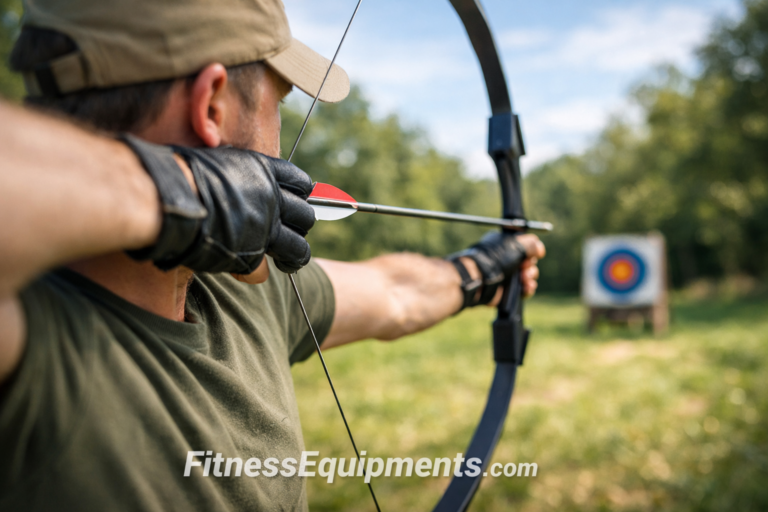
The stillness of an archer at full draw is one of the most misleading images in all of sport. What looks like a person standing quietly is actually a full-body isometric effort that demands more than it shows. Drawing a competition recurve bow requires overcoming between 34 and 50 pounds of resistance — sustained, not in a single explosive movement, but held steady while the archer aims, breathes, and times the release. The muscles engaged include the shoulders, trapezius, rhomboids, biceps, triceps, core, and legs, all working simultaneously to hold a position of controlled tension precise enough to hit a target the size of a dinner plate from 70 meters away.
At a competitive level, this is not done once. In Olympic-format competition, archers shoot 72 arrows in a qualification round alone. In multi-day tournaments, an archer may draw their bow more than 300 times across the competition. The physical toll is cumulative in a way that a single dramatic moment of exertion does not capture. Competitive archers train with the same program structure as other athletes — cardiovascular conditioning, resistance training, and sport-specific technical practice. The idea that archery requires no athletic preparation is one that lasts exactly until the moment a skeptic picks up a competition bow and attempts to hold it at full draw for six seconds.
Mental Athleticism and Why It Counts
One of the ways archery challenges conventional sport definitions is through the weight it places on mental performance. This is not a weakness in archery’s case — it is one of its strongest arguments. Every physical skill in archery is mediated by mental control. The draw is physical. The aim is physical. But the decision of when to release, the management of breath, the suppression of the body’s natural tremor response, the maintenance of concentration across hours of competition — these are mental athletic skills of the highest order.
Sports science has documented the physiological reality of archery’s mental demands. An archer at full draw experiences elevated heart rate, increased adrenaline, and the same performance anxiety responses as athletes in contact sports. Managing those responses while executing a movement pattern precise enough to land arrows in a ring 10 centimeters wide from 70 meters away is not a passive activity. It is an athletic performance that most people could not replicate regardless of their physical conditioning. The mental dimension of archery does not disqualify it as a sport. It deepens the case for it.
The Olympic Standard and What It Actually Means
Archery first appeared at the Olympic Games in 1900 in Paris. It was contested again in 1904, 1908, and 1920 before a gap of 52 years during which inconsistent international rules made it difficult to standardize as an Olympic discipline. It returned permanently in 1972 at the Munich Games and has been part of every Summer Olympics since. Today, according to World Archery, the sport is governed by a formal international federation that maintains world rankings, publishes an official rulebook, and organizes major events including the World Archery Championships, the Archery World Cup, and the Indoor Archery World Series.
Olympic inclusion is not a rubber stamp that automatically settles every debate about sport, but it is meaningful context. The International Olympic Committee applies a rigorous set of criteria before including any discipline — anti-doping compliance, international federation governance, worldwide participation, and demonstrated competitive structure among them. Archery has met every one of those criteria for over 50 consecutive years. The Republic of Korea alone has won 43 Olympic archery medals, 27 of them gold, built on a national development program that treats archery as the elite athletic discipline it is.
Archery as a Sport Across Every Discipline
Part of what makes archery’s case so strong is the breadth of competitive formats it encompasses. The Olympic discipline — outdoor target archery with recurve bows at 70 meters — is the most visible, but it represents only one corner of the sport. Field archery takes competitors through natural terrain shooting at targets at varying distances, heights, and angles, demanding a completely different skill set from the controlled environment of a target range. Indoor archery compresses the discipline into an 18-meter format that rewards a different kind of precision. Para archery brings the sport to athletes with physical impairments, making archery one of the rare competitive activities where able-bodied and impaired athletes train on genuinely comparable equipment under the same governing rules.
Beyond those core disciplines, 3D archery — in which competitors shoot at life-size animal targets at unknown distances — tests distance judgment and field craft alongside technical shooting skill. Horseback archery, one of the oldest competitive forms, combines equestrian athleticism with shooting precision in a way that makes almost any argument against archery as a sport difficult to sustain with a straight face.
Why the Debate Has Persisted Despite the Evidence
Given the weight of historical, physical, and institutional evidence, the persistence of the “is archery a sport” debate says more about cultural bias than it does about archery. Spectator sport culture in the modern era has been shaped primarily by ball sports and contact athletics — formats where exertion is immediate, dramatic, and legible to someone watching from the stands. Archery’s demands are largely invisible to a casual observer. The effort happens inside the body, inside the mind, and in the stillness before the release rather than in the explosive aftermath of it.
This makes archery harder to market as a spectacle than a contact sport, but it does not make it less of a sport. Swimming laps in a pool is not visually dramatic either. The effort of a long-distance runner in the middle miles of a marathon is not readable on their face. We do not question those as sports because they fit established templates. Archery’s template is older than almost all of them — it simply does not look like what a 21st-century sports broadcast has conditioned us to expect.
The Verdict 10,000 Years in the Making
Is archery a sport? By every serious standard — physical demand, technical skill, formal competitive structure, governing body oversight, and Olympic recognition — the answer has never genuinely been in question. The evidence stretches back further than any other competitive athletic tradition still practiced today. Archery was developing athletes, creating champions, and building competitive institutions while the ancestors of football and basketball were still centuries away from being invented.
The people who still ask the question are not engaging with archery’s history or its physical reality. They are applying a definition of sport that was built around the games they grew up watching and mistaking that familiarity for a universal standard. Archery does not need to defend itself against that standard. If anything, the standard needs to be expanded to accommodate one of humanity’s oldest and most demanding competitive disciplines. Ten thousand years of evidence has already made the case. The rest is just catching up.