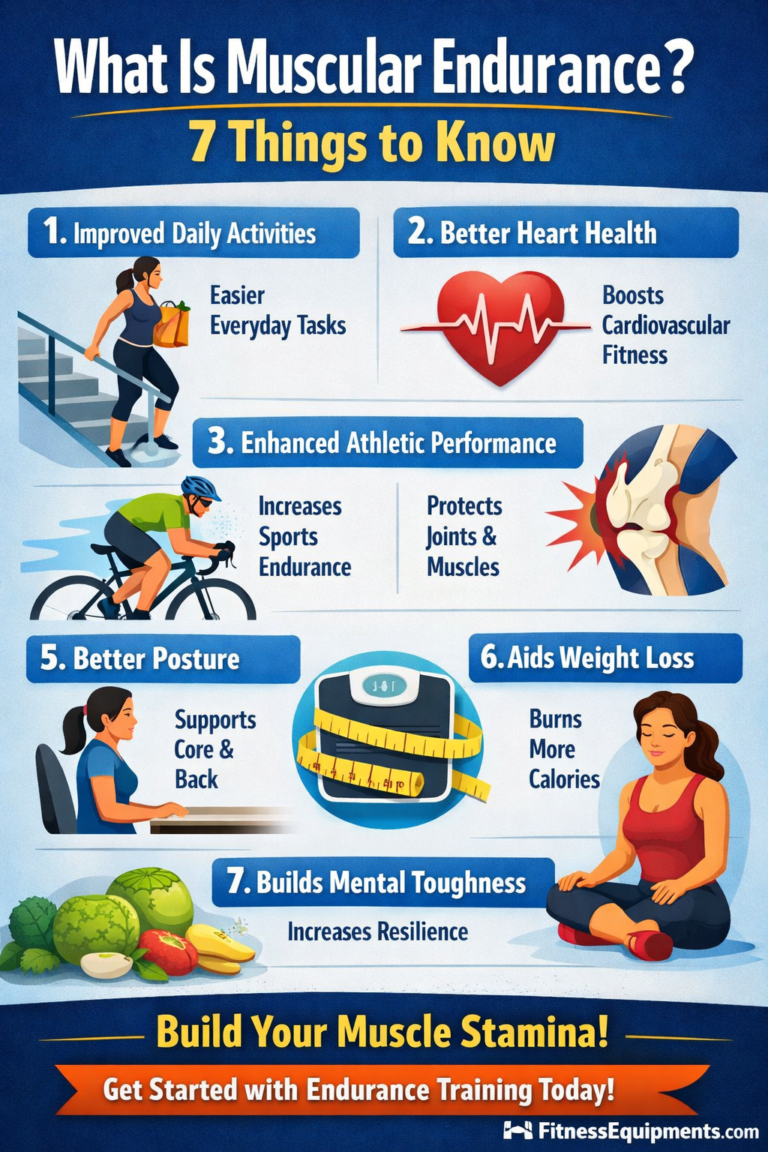
Most people associate strength training with lifting heavy for a few reps, but muscular endurance examples show a completely different side of fitness. Muscular endurance is the ability of a muscle or group of muscles to perform repeated contractions over time without giving out. Whether you are a beginner stepping into the gym for the first time or an experienced athlete looking to improve stamina, these exercises belong in your routine.
What Is Muscular Endurance?
Muscular endurance refers to how long a muscle can sustain effort before fatigue sets in. It is different from raw strength, which measures how much force a muscle can produce in a single effort. Think of it this way: strength is lifting the heaviest box once, while endurance is carrying a lighter box up several flights of stairs without stopping.
Training for muscular endurance typically involves lighter resistance with higher repetitions, usually 15 reps or more per set. Rest periods are kept short, often 30 to 60 seconds, to challenge the muscles to recover quickly and keep working.
Why Muscular Endurance Matters
Building muscular endurance benefits daily life as much as it benefits performance in the gym. Everyday tasks like carrying groceries, climbing stairs, and playing with kids all demand sustained muscular effort. Better endurance also reduces the risk of injury by helping muscles support joints more effectively over extended periods.
Athletes in sports like swimming, cycling, rowing, and long-distance running depend heavily on muscular endurance. Even strength-focused athletes benefit because improved endurance helps them maintain form during longer training sessions. Over time, better muscular endurance also supports faster recovery between sets and between workouts, which allows for more consistent training overall.
10 Muscular Endurance Examples to Try
The following muscular endurance examples cover a range of muscle groups and difficulty levels. Each exercise can be scaled up or down based on your current fitness.
1. Bodyweight Squats
Bodyweight squats target the quadriceps, hamstrings, and glutes. Performing high-rep sets of 20 to 50 repetitions challenges the lower body to maintain output over an extended period. Keep your chest upright, push your hips back, and lower until your thighs are at least parallel to the ground.
2. Push-Ups
Push-ups are one of the most accessible endurance exercises for the upper body. They work the chest, shoulders, and triceps. Aim for sets of 20 or more with controlled form. If standard push-ups are too challenging, start from your knees and build volume over time.
3. Plank Hold
The plank is an isometric exercise that builds endurance in the core, shoulders, and lower back. Hold the position with a straight line from head to heels. Start with 30-second holds and progress toward 60 seconds or longer as your core strengthens.
4. Walking Lunges
Walking lunges build endurance in the quads, glutes, and hip stabilizers. Step forward into a lunge, lower your back knee toward the ground, and drive forward into the next step. Performing 20 to 40 continuous reps turns this into a serious stamina challenge.
5. Wall Sit
The wall sit is another isometric hold that targets the quadriceps. Slide your back down a wall until your thighs are parallel to the floor and hold that position. A 45-second to 90-second hold is a solid benchmark for intermediate fitness levels.
6. Jumping Jacks
Jumping jacks combine muscular endurance with cardiovascular demand. They engage the calves, shoulders, and hip abductors. Sets of 50 to 100 reps at a steady pace challenge both muscle stamina and aerobic capacity at the same time.
7. Dumbbell Shoulder Press
Using a light pair of dumbbells, the shoulder press builds endurance in the deltoids and triceps. Choose a weight that allows you to perform 20 or more reps with clean form. This is an effective way to prepare the shoulders for activities that require sustained overhead effort.
8. Bicycle Crunches
Bicycle crunches target the rectus abdominis and obliques through a repeated twisting motion. Perform 30 to 50 reps per set while keeping a controlled tempo. Focus on fully rotating the torso rather than just moving the elbows.
9. Step-Ups
Step-ups onto a bench or sturdy platform work the glutes, quads, and calves. Performing 15 to 25 reps per leg without resting builds single-leg endurance and improves balance at the same time. Keep your torso upright and drive through the heel of the working leg.
10. Light Deadlifts
Using a barbell or dumbbells at roughly 40 to 50 percent of your one-rep max, perform deadlifts for sets of 15 to 20 reps. This builds endurance in the glutes, hamstrings, and lower back. Maintain a neutral spine throughout every repetition to protect the lower back.
How to Program These Muscular Endurance Examples
To build a workout around these exercises, pick four to six movements that cover different muscle groups. Perform two to three sets of each exercise with 15 or more reps per set. Keep rest periods between 30 and 60 seconds.
Train for muscular endurance two to three days per week. Gradually increase the number of reps or the duration of isometric holds as your body adapts. Progression should feel challenging but sustainable. If your form breaks down before the set is finished, reduce the rep count and build back up.
Pairing upper body and lower body exercises in a circuit format is an efficient way to keep heart rate elevated while giving individual muscle groups a short recovery window.
Common Mistakes to Avoid
Going too heavy is the most frequent mistake people make when training for endurance. The goal is sustained effort, not maximal load. If you cannot complete at least 15 reps with good form, the weight is too heavy for an endurance-focused set.
Rushing through reps is another common issue. Speed without control reduces muscle engagement and increases injury risk. Focus on a steady tempo, especially on the lowering phase of each movement.
Skipping warm-ups is also a mistake that catches up with people quickly. A five-minute warm-up of light movement and dynamic stretches prepares the muscles and joints for the higher rep ranges that endurance training demands. Cold muscles fatigue faster and are more prone to strains, so this step should never be skipped regardless of how short your session is.
Frequently Asked Questions
How often should I train muscular endurance?
Two to three sessions per week is enough for most people. Allow at least one rest day between sessions targeting the same muscle groups to give your body time to recover and adapt.
Can I build muscular endurance at home?
Yes. Many of the best exercises for muscular endurance use only bodyweight. Squats, push-ups, planks, lunges, and jumping jacks all require no equipment and can be done in a small space.
What is the difference between muscular endurance and muscular strength?
Muscular strength measures the maximum force a muscle can produce in one effort. Muscular endurance measures how many times a muscle can repeat a movement or how long it can hold a position before fatigue sets in. Both are important, but they are trained differently.
Will muscular endurance training make me bulky?
No. Endurance training uses lighter loads and higher reps, which builds lean, fatigue-resistant muscle rather than significant size. Gaining bulk requires heavy resistance and a caloric surplus, which is a different training approach entirely.