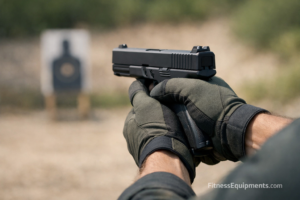
Here is the contradiction nobody in the shooting gloves market wants to say out loud: the more a glove protects your hands, the more it gets between you and your firearm. Heavy padding absorbs recoil — and deadens trigger feel. Thick insulation keeps your fingers warm — and makes them slow. Full-finger reinforcement shields against abrasions — and costs you the tactile sensitivity that accurate shooting depends on. This is not a flaw in any one brand. It is a fundamental tension built into the design of every pair of shooting gloves ever made. The mistake most shooters make is buying for maximum protection when they should be buying for the right balance — and that balance is completely different depending on how and where they shoot. This guide cuts through the noise to show you exactly what to prioritize based on your discipline, your conditions, and the way your hands need to work when it matters most.
The Protection vs. Performance Trap
Every pair of shooting gloves is making trade-offs, whether the marketing copy admits it or not. The three competing demands in any glove design are protection, dexterity, and tactile sensitivity. Increase one and you almost always reduce another. A glove engineered for maximum impact protection on the knuckles adds material and stiffness, restricting hand movement. A glove built for total weather protection layers insulation that numbs the fingertips. A glove designed for the most responsive trigger feel is, almost by definition, less physically protective than a heavier option.
This is not a reason to avoid wearing shooting gloves — it is a reason to choose them deliberately. The shooters who get the most out of their gloves are not the ones who bought the highest-rated product in a roundup. They are the ones who understood which trade-offs were acceptable for their specific use and which ones they could not afford to make.
The Features That Quietly Kill Your Performance
Before looking at discipline-specific recommendations, it helps to understand which features are most likely to work against you — because they appear on many of the most popular shooting gloves on the market.
Palm padding. Foam or gel padding in the palm is marketed as recoil reduction, and it does reduce the sting of heavy-recoiling firearms over a long session. But the same material that cushions your palm changes how the grip sits in your hand and creates a layer of deadening between you and the trigger reset. For shooters running fast drills or competitive stages, this matters significantly. If you are shooting a .22 at paper targets on a Sunday afternoon, it probably does not.
Seam placement. Interior seams that run across the palm or along the inside of the trigger finger are among the most overlooked problems in shooting glove design. These seams create pressure points that shift your grip and reduce sensitivity exactly where precision matters most. A well-designed pair of shooting gloves will have minimal interior seaming, with any necessary seams placed on the back of the hand where they do not interfere with your hold.
Uniform full-finger construction. Many tactical shooting gloves apply the same material and thickness across all fingers for a clean, uniform look. In practice, this means the trigger finger gets the same treatment as the pinky — which makes no sense for shooting performance. Look for gloves that thin out or cut away the trigger finger rather than treating it like every other digit.
How to Choose Shooting Gloves for Your Discipline
Competitive and Range Shooting
Competitive shooters live and die by trigger feel and reload speed. For this discipline, shooting gloves need to disappear as much as possible — you want protection from abrasions and heat without any interference in what your hands are doing. Thin goatskin leather or synthetic suede construction with no palm padding and flat or seamless finger construction is the target. Many competitive shooters prefer a half-finger or trigger-finger-cut design to keep sensitivity as close to bare-hand as possible while still protecting the palm and the back of the hand. Touchscreen compatibility is a practical bonus here since shot timers and training apps are part of the modern range session.
Hunting and Wing Shooting
Hunting introduces a challenge that range shooting rarely does — long periods of stillness in cold conditions followed by the need to shoot accurately the moment an opportunity presents itself. A glove that is too insulated makes your hands stiff and slow at precisely the wrong moment. The traditional material of choice among wing shooters is thin deerskin or doe skin leather. It provides natural warmth without bulk, develops an exceptional grip as it breaks in, and molds to the contours of your hand over time in a way no synthetic material can match. For most hunting conditions, avoid heavy insulation fills unless you are in genuinely extreme cold — and even then, consider a lighter glove worn under a removable outer shell rather than a single heavy glove that you cannot take off cleanly when the shot presents itself.
Tactical and Home Defense Training
Tactical applications and home defense training sessions place different demands on shooting gloves than sport or hunting use. Here, durability and comprehensive protection justify more material. Reinforced knuckles, abrasion-resistant palms, and a secure wrist closure all make sense in this context. The trade-off in protection is more acceptable — but it still should not be total. Even tactical shooting gloves should thin out at the trigger finger. A ventilated or isolated trigger finger construction preserves enough sensitivity to manipulate the firearm safely under stress without leaving that finger unprotected. According to the NRA’s fundamental rules of firearm safety, keeping your finger off the trigger until ready to shoot is a non-negotiable discipline — and your gloves should support that habit, not work against it.
Cold Weather Range Sessions
Cold weather shooting gloves are arguably the hardest balance to strike in the entire category. Insulation is necessary, but insulation means bulk, and bulk kills dexterity. The shooters who handle this best tend to choose gloves built with thin performance insulation — Thinsulate or similar materials — rather than thick fleece or foam fills. Another effective design approach is asymmetric construction: windproofing and insulation concentrated on the back of the hand where cold penetrates most, with a thinner palm and trigger finger for preserved dexterity. This keeps shooting performance intact while blocking the cold that matters most. Whatever you choose, test your cold-weather shooting gloves at the range before you need them in the field — cold hands and an unfamiliar glove are a combination that catches shooters off guard every time.
Fit Is the Variable That Overrides Everything Else
The best-designed pair of shooting gloves in any category will underperform if the fit is wrong. A glove that is too large bunches in the palm, shifts during recoil, and creates exactly the kind of interference that good design is supposed to eliminate. A glove that is too tight restricts blood flow, fatigues the hand faster, and makes fine motor tasks — loading magazines, manipulating controls, operating a bolt — harder than they need to be.
Sizing between brands varies enough that your standard size is not a reliable starting point. Measure the circumference of your dominant hand at the widest point of the palm, and measure the length of your middle finger from base to tip. Cross-reference both measurements against the brand’s specific size chart rather than relying on general sizing. If you fall between sizes, leather shooting gloves will break in and conform to your hand over time — size down slightly if the glove is leather and you are caught between two measurements. Synthetic gloves do not stretch, so size up when in doubt.
Matching Material to Purpose
Material choice matters, but not in the way most product descriptions frame it. The question is not which material is best in the abstract — it is which material makes the right trade-offs for what you are doing.
Goatskin leather is the most versatile option across disciplines. It is thin enough to preserve reasonable dexterity, durable enough to hold up through heavy use, and develops a natural grip as it breaks in. Doe skin takes those qualities further — even thinner, more sensitive, and more conforming to the hand, which is why it has been the preferred material for traditional hunters and wing shooters for generations. If you do one thing with this information, let it be this: any shooter who has never tried a quality deerskin glove is missing a standard that no synthetic has managed to fully replicate.
Synthetic suede is consistent and low-maintenance. It does not require conditioning, performs the same in session one as it does in session one hundred, and is usually touchscreen compatible out of the box. It lacks the natural feel and break-in quality of leather but is a solid choice for competitive and range use where consistency matters more than character.
Neoprene handles wet conditions better than any leather option. It is stretchy, weatherproof, and holds up in rain and humidity where leather would become stiff and slippery. The trade-off is reduced tactile sensitivity and a slightly synthetic feel on the grip — acceptable for wet-weather use, less ideal as an everyday range glove.
Heavy insulating fills — thick fleece, foam, or down — belong only in extreme cold-weather applications where warmth genuinely outranks dexterity. For the vast majority of shooting conditions, these materials create more problems than they solve. If you find yourself reaching for a heavily insulated glove, ask whether a lighter glove paired with hand warmers during waiting periods would serve you better when the moment to shoot actually arrives.
The Right Shooting Gloves Work With You, Not Against You
The protection-versus-performance tension in shooting gloves is real, but it is not a problem without a solution. It is a design puzzle with a different answer for every shooter depending on their discipline, their conditions, and what their hands need to do under pressure. The shooters who get this right are not the ones who bought the most-reviewed gloves or the most heavily padded ones. They are the ones who understood the trade-offs clearly and chose accordingly.
Prioritize tactile sensitivity and seam placement over padding and bulk. Match insulation to your actual conditions, not to a worst-case scenario you may never encounter. Get the fit right before evaluating anything else. A well-chosen pair of shooting gloves that matches your discipline and fits your hands correctly will make you more capable at the range — not less. That is the whole point, and it is the standard every pair of shooting gloves you ever buy should be held to.


