Let’s start with an honest question: How many pieces of exercise equipment have you bought over the years that ended up as expensive coat racks?
You’re not alone. We’ve all been there—seduced by an infomercial at 2 AM, convinced that this will be the machine that changes everything. Three weeks later, it’s buried under laundry.
But here’s the thing. Finding the right exercise equipment for seniors isn’t about buying the fanciest gadget. It’s about finding something that fits your body, your life, and your reality—not the reality of some fitness model half your age.
This guide is different. No pressure. No guilt trips about “getting back in shape.” Just honest, practical advice about equipment that real people actually enjoy using.
Ready? Let’s dive in.
Why This Matters More Than You Think
Maybe your doctor mentioned something about staying active. Maybe your knees remind you every morning that things aren’t what they used to be. Or maybe you just want to keep up with the grandkids without feeling winded.
Whatever brought you here, know this: you’re already ahead of most people just by looking.
The right exercise equipment for seniors isn’t about training for a marathon. It’s about something simpler and more important—staying independent. Being able to carry groceries without help. Getting up from a chair without grabbing the armrest. Walking to the mailbox without worrying about your balance.
According to the Centers for Disease Control and Prevention, adults over 65 need about 150 minutes of moderate activity per week. That sounds like a lot until you realize it’s just 20-ish minutes a day.
The trick? Making those 20 minutes easy to do.
That’s where the right equipment comes in.
Before We Talk Equipment: A Quick Reality Check
Here’s what nobody tells you about senior fitness equipment: the “best” machine is the one you’ll actually use.
Not the one with the most features. Not the one your neighbor swears by. Not the one that got five stars on Amazon.
The one that fits you.
So before we get into specific recommendations, ask yourself a few questions:
What are you actually worried about?
- Falling? (Balance equipment matters most)
- Heart health? (Cardio machines are your friend)
- Losing strength? (Resistance training is key)
- Joint pain? (Low-impact options only)
Where will you use it?
- Living room while watching TV?
- Spare bedroom?
- Garage?
What’s your honest budget?
- Under $100?
- $100-500?
- $500+?
Do you have anyone to help with setup?
- Some equipment arrives in 47 pieces with instructions written by someone who clearly hates humanity.
Keep your answers in mind as we go through the options.
The 7 Best Exercise Machines for Older Adults
1. Recumbent Exercise Bikes: The Crowd Favorite
If I could only recommend one piece of exercise equipment for seniors, this would be it.
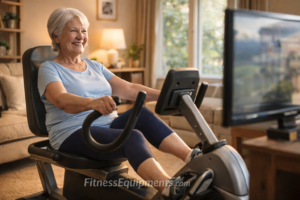
Picture this: You’re sitting in a comfortable chair with back support. Your feet rest on pedals in front of you—not underneath you. There’s no balancing. No climbing. No stress on your knees. You just… pedal.
That’s a recumbent bike.
Why seniors love them:
- The reclined position supports your lower back completely
- Getting on and off is simple (no leg swinging required)
- You can read, watch TV, or video chat while pedaling
- Resistance adjusts easily from “gentle warm-up” to “okay, I’m working now”
Real talk: A neighbor of mine, 72 years old, uses hers every single morning while watching the news. She told me, “It doesn’t feel like exercise. It just feels like sitting—but productive.”
That’s the goal, right?
What to look for:
- Seat that adjusts forward and backward
- Heart rate monitor on the handles
- Magnetic resistance (quieter and smoother than fan-based)
- Cup holder (yes, really—hydration matters)
Budget: $200-$600 for quality options.
2. Pedal Exercisers: Small But Mighty
Not everyone has room for a full-sized machine. Maybe you live in an apartment. Maybe you’re testing the waters before committing to something bigger. Maybe you just want something simple.
Enter the pedal exerciser.
This little device sits on the floor in front of any chair or couch. You pedal while seated wherever you’re comfortable—your favorite recliner, the couch, even a wheelchair.
Why they’re brilliant:
- Cost under $50 for decent models
- Store under a bed or in a closet
- Zero learning curve
- Perfect for circulation during TV time
The honest truth: These won’t give you an intense cardio workout. But that’s not the point. They keep your legs moving, your blood flowing, and your joints active. For many seniors, that’s exactly enough.
One woman I spoke with uses hers during her afternoon soap operas. “I barely notice I’m doing it,” she said. “But my legs feel so much better than when I just sit there.”
Sometimes simple wins.
3. Resistance Bands: Don’t Let the Simplicity Fool You
I know what you’re thinking. Rubber bands? Really?
Yes. Really.
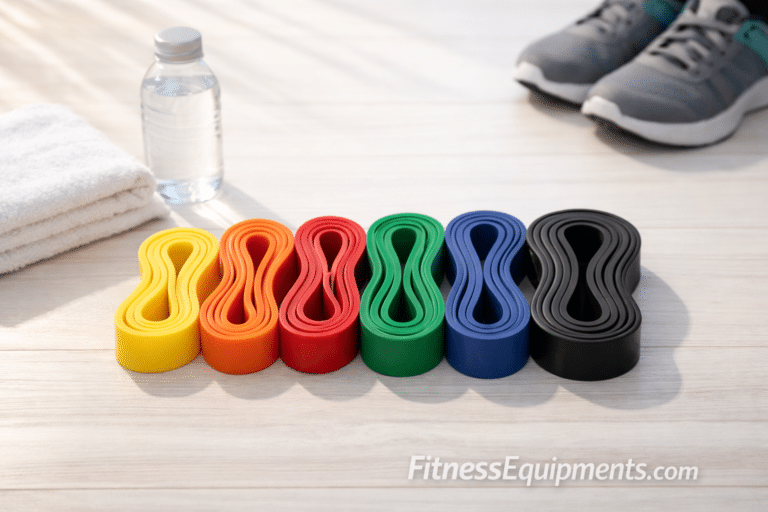
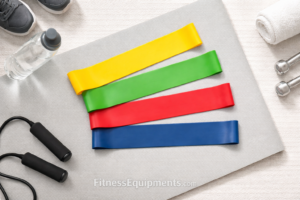
Resistance bands are sneaky effective. Physical therapists use them constantly—and not just for beginners. These stretchy loops and tubes provide strength training without the intimidation of heavy weights or complicated machines.
Why they work for seniors:
They’re progressive. Start with a light band (usually yellow or green). As you get stronger, move to medium, then heavy. Your body adapts gradually without sudden jumps in difficulty.
They’re joint-friendly. Unlike dumbbells, bands create tension throughout the entire movement. No jerky motions. No dropped weights. Just smooth, controlled resistance.
They’re versatile. Arms. Legs. Back. Core. One $20 set of bands replaces an entire weight rack.
How to start: Look for a set with multiple resistance levels, a door anchor, and an instruction guide. Better yet, ask your doctor for a physical therapy referral—many insurance plans cover a few sessions where you’ll learn exactly how to use them safely.
4. Elliptical Trainers: Full-Body Without the Impact
Here’s a memory: Walking used to feel easy. Now, maybe your hips complain. Your knees protest. Your ankles have opinions.
Walking is still one of the best exercises out there—but the impact adds up.
Ellipticals solve this problem beautifully.
Your feet stay on the pedals the whole time, gliding in smooth ovals. No pounding. No jarring. Your arms move with the handles, so you’re working upper and lower body simultaneously.
The catch: Traditional ellipticals require balance and a moderately high step to mount them. That’s a dealbreaker for some seniors.
The solution: Look for models designed with seniors in mind:
- Low step-on height (under 10 inches)
- Extra-long stationary handles for support
- Wide, stable base
- Some models even include seats for rest breaks
Is it worth the investment? If you miss walking but your joints won’t cooperate, absolutely. Ellipticals provide that same rhythmic, meditative movement without the punishment.
Budget: $400-$1,200 for senior-friendly models.
5. Balance Boards and Trainers: Your Secret Weapon Against Falls
Can we talk about something uncomfortable for a moment?
Falls.
They’re one of the biggest fears for seniors—and one of the biggest risks. A simple stumble can mean months of recovery, lost independence, or worse.
But here’s the good news: balance can be trained. It’s not just something you have or don’t have. Like strength, it improves with practice.
Balance boards are deceptively simple tools. You stand on an unstable surface—a wobble board, a foam pad, a rocker platform—and your body works constantly to stay upright. Your core engages. Your ankles strengthen. Your brain sharpens its balance reflexes.
Starting safely:
- Position near a wall or sturdy furniture
- Begin with just 30 seconds at a time
- Progress slowly—this is not a race
Does it actually work? Studies consistently show that balance training reduces fall risk significantly. Physical therapists recommend it universally. And honestly? It’s kind of fun in a “can I do this?” challenge sort of way.
Budget: $30-$150.
6. Water Rowing Machines: The Surprisingly Gentle Powerhouse
When someone mentions rowing machines, you might picture sweaty athletes grunting through brutal workouts.
Forget that image.
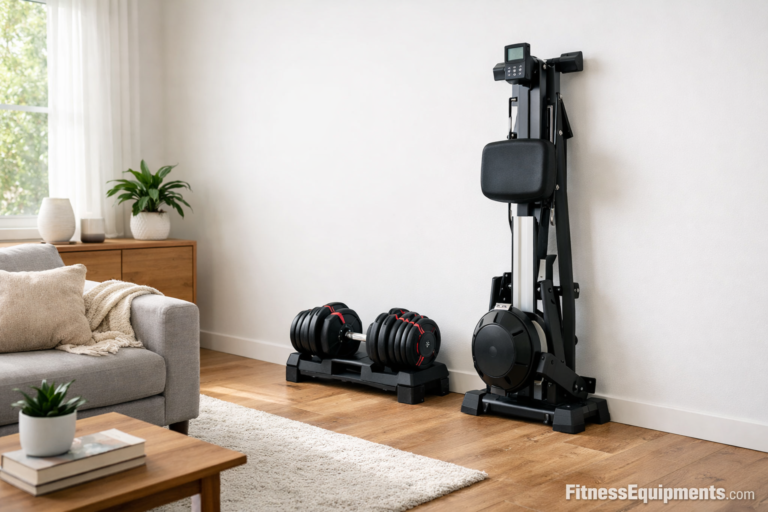
Water rowers—specifically—offer something different. The resistance comes from a water tank, which means it naturally adjusts to your effort. Pull gently, and the resistance is gentle. Pull harder, and it increases. No settings to fiddle with. No jarring resistance spikes.
Why this matters for seniors:
The seated position eliminates fall risk entirely. The motion engages legs, core, back, arms, and shoulders—making it one of the most complete full-body workouts available. And the sound? That gentle swoosh of water is genuinely calming.
The learning curve: Rowing technique matters. Poor form can strain your back. Consider watching instructional videos or booking one session with a trainer to learn the basics before committing.
Who should skip this: Anyone with significant back problems should consult their doctor first. The rowing motion, even when done correctly, involves the lower back.
Budget: $500-$1,500.
7. Adjustable Dumbbells: Old School for Good Reason
Sometimes the simplest tools work best.
Dumbbells have been around forever because they work. They build strength. They preserve bone density (crucial as we age). They maintain muscle mass that naturally declines with each passing year.
Modern adjustable dumbbells condense an entire weight rack into a single set. Turn a dial or slide a pin, and you switch from 5 pounds to 25 pounds instantly.
Why seniors should consider them:
Strength training is no longer optional after 60—it’s essential. We lose muscle mass naturally every year. Without resistance training, everyday tasks become harder. Carrying groceries. Opening jars. Standing up from low chairs.
Dumbbells fight back against that decline.
Safety first:
- Start lighter than you think you need
- Learn proper form before adding weight
- Never sacrifice technique for heavier loads
- Consider a few personal training sessions
Budget: $200-$500 for quality adjustable sets.
Building Your Home Gym for Elderly-Friendly Fitness
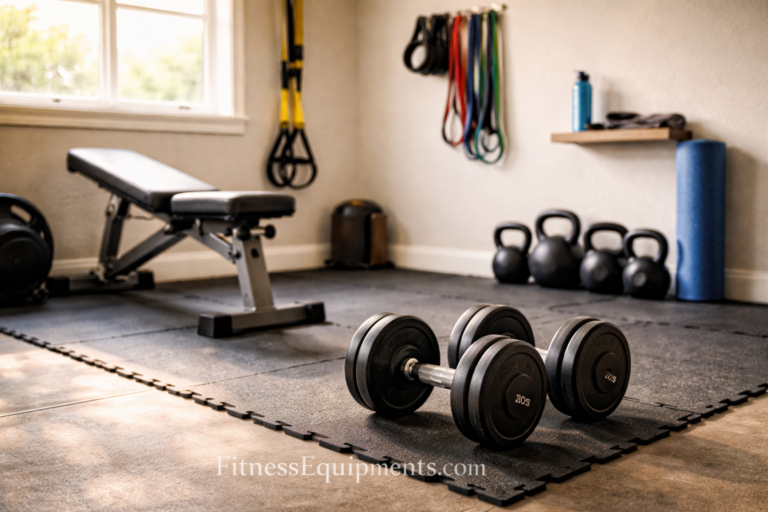
You don’t need a basement full of equipment. You don’t need thousands of dollars. You need a few key pieces that you’ll genuinely use.
Here’s a practical approach:
The Minimalist Setup ($100-150):
- Pedal exerciser
- Resistance band set
- Basic balance board
This covers cardio, strength, and balance—the three pillars—for less than a nice dinner out.
The Comfortable Setup ($400-700):
- Recumbent bike
- Resistance band set
- Balance trainer
Now you’re set for serious, enjoyable, sustainable fitness.
The Complete Setup ($1,000-2,000):
- Recumbent bike OR elliptical
- Water rower
- Adjustable dumbbells
- Balance board
- Resistance bands
This covers everything. Full-body strength. Cardio options. Balance work. Variety to prevent boredom.
Making It Stick: The Part Nobody Talks About
Here’s where most fitness articles end: “Buy this equipment and you’ll be healthy!”
But we both know that’s not how life works.
Equipment sits unused. Motivation fades. Life gets in the way.
So let’s talk about the real challenge: actually using the stuff.
Start Embarrassingly Small
Forget hour-long workouts. Forget “no pain, no gain.”
Start with five minutes. Literally five minutes. Set a timer. When it goes off, you’re done.
“But five minutes won’t make a difference!”
Actually, it will. Because five minutes today becomes five minutes tomorrow. And next week, maybe you feel like doing seven minutes. Then ten. Then suddenly you’re doing 20 minutes without even thinking about it.
The habit matters more than the duration.
Attach It to Something You Already Do
You already watch TV in the evening, right?
What if the rule was: “I only watch my favorite show while pedaling.”
That’s not discipline. That’s just… pairing.
Coffee in the morning? Do some light resistance band stretches first.
Waiting for a phone call? Stand on the balance board.
Fitness becomes invisible when it’s attached to existing routines.
Tell Someone
Accountability works. Tell your spouse. Tell your kids. Tell your neighbor.
“I’m going to use my recumbent bike three times this week.”
Something shifts when you say it out loud to another human. It stops being optional.
Forgive Yourself Constantly
You’ll miss days. You’ll have weeks where the equipment gathers dust.
That’s normal. That’s human. That’s fine.
The only failure is giving up entirely. Every day is a new chance to start again.
Common Questions About Exercise Equipment for Seniors
“What if I have bad knees?” Recumbent bikes and ellipticals are your best friends. Both minimize knee stress while still providing excellent workouts. Avoid steppers or anything with climbing motions.
“What if I have balance problems?” Start with seated equipment—recumbent bikes, pedal exercisers, seated steppers. Once you build some strength and confidence, introduce balance training with proper support nearby.
“Is used equipment okay?” Absolutely. Check for wear, test all functions, and inspect carefully—but quality used equipment is perfectly fine. Check Facebook Marketplace, Craigslist, or estate sales.
“What if I live in a small space?” Pedal exercisers fold away. Resistance bands fit in a drawer. Folding recumbent bikes exist. You have options.
“Should I check with my doctor first?” If you have heart conditions, recent surgeries, severe joint problems, or any chronic illness—yes. A quick conversation ensures you choose appropriate equipment and avoid unnecessary risks.
Final Thoughts: You’re Already Doing the Hard Part
Here’s what impresses me about you: you’re here. You’re reading this. You’re taking your health seriously at a time when it would be easy to just… not.
That matters.
The right exercise equipment for seniors isn’t about becoming a gym rat or training for competitions. It’s about staying independent. Staying mobile. Staying you.
Pick one piece of equipment from this list. Just one. Start small. Build slowly. Forgive yourself on the hard days.
Your future self—the one still playing with grandkids, still walking without worry, still living fully—will thank you.